
On June 30 and July 1, funders convened in Washington, D.C. during our 2025 Funders Institute. During the event, participants learned from movement leaders about what is needed from philanthropy in this moment and why showing up and working differently is essential to move towards the future we want to see.
Day 1 Opening Remarks
The 2025 Funders Institute opened with a heartfelt welcome from Funders Together CEO Amanda Andere as she participated in her last Funders Institute, reflecting on the “season of change” our organization is in. She announced our official name change to Funders Together for Housing Justice and led attendees through our journey and decision-making process around the new organizational name, what it represents in this moment, and what it means for our work.
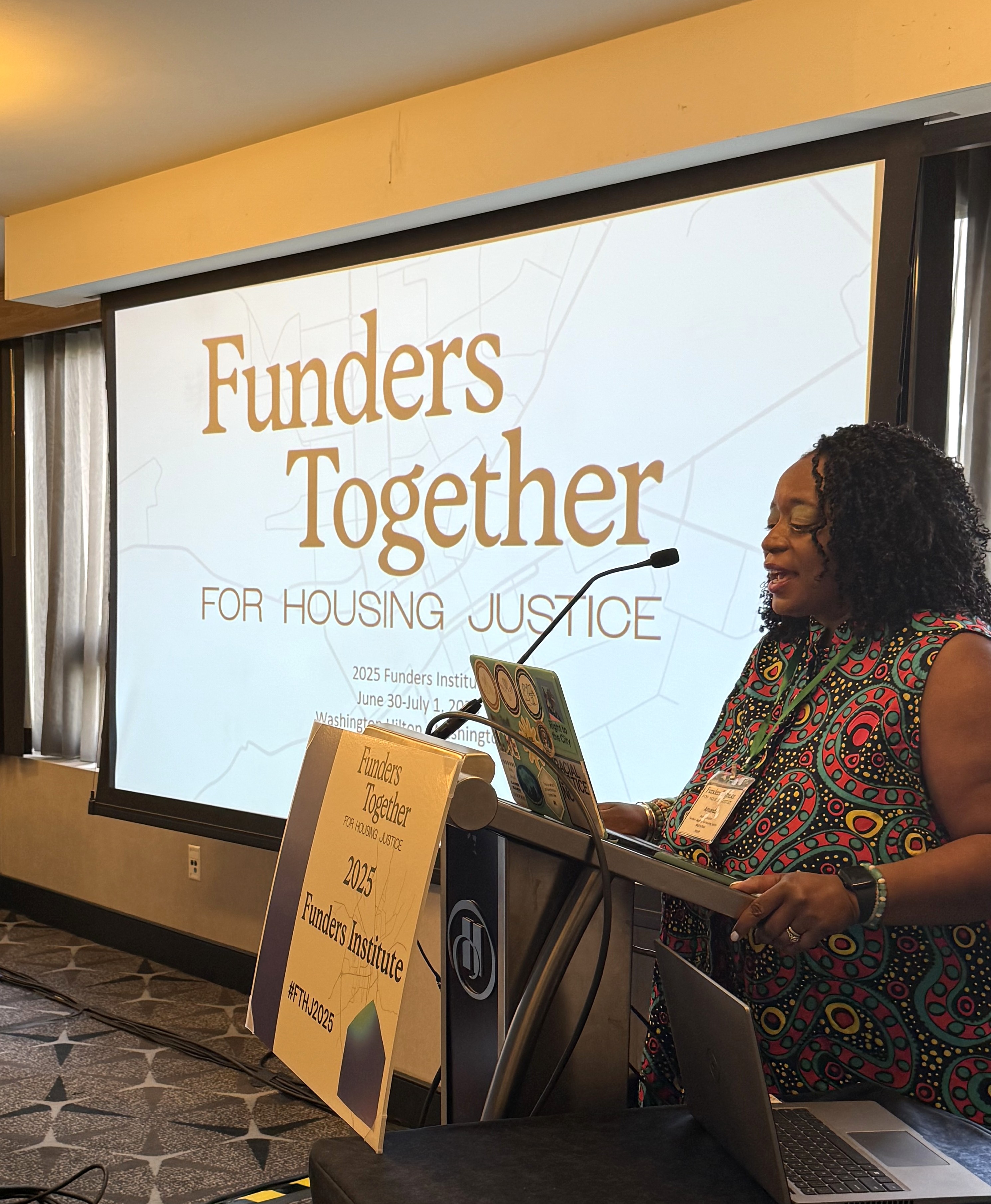 Funders Together CEO Amanda Andere welcomes participants to the 2025 Funders Institute
“Trust us to walk you through this transition,” said Amanda as she outlined how this name change doesn’t represent a change in mission. Funders Together will always focus on people at the sharpest intersections of oppression and marginalization, including people experiencing homelessness, those who are Black, Indigenous, and other people of color, immigrant neighbors, and disabled and LGBTQ+ people.
She also encouraged participants to stay steadfast to our collective commitments to housing justice by inviting us to pause—not just in reflection, but in recognition. She reminded us that housing justice is not just about systems or strategy; it’s about people. It’s about movement-building rooted in love, led with clarity, and committed to disruption. Under Amanda’s leadership, Funders Together grew into an unapologetically pro-Black, pro-Indigenous, and pro-LGBTQ+ organization—one that challenges philanthropy to not only support justice but to practice it. Her call to the room was simple and urgent: “Don’t go back to your usual. Leave this space and move differently.”
This set the stage for Ann Oliva, CEO of the National Alliance to End Homelessness (NAEH), to join the conversation, highlighting how NAEH is approaching the work to end homelessness during the ongoing. She stressed how the current political environment requires all advocacy organizations and groups to think differently about how we do this work: some are better positioned to block policies that harm people experiencing homelessness while others are uniquely positioned to build towards a future in which housing justice is a reality. The question is how do we do that in concert to intentionally co-create with community and people who are most impacted by housing insecurity and homelessness?
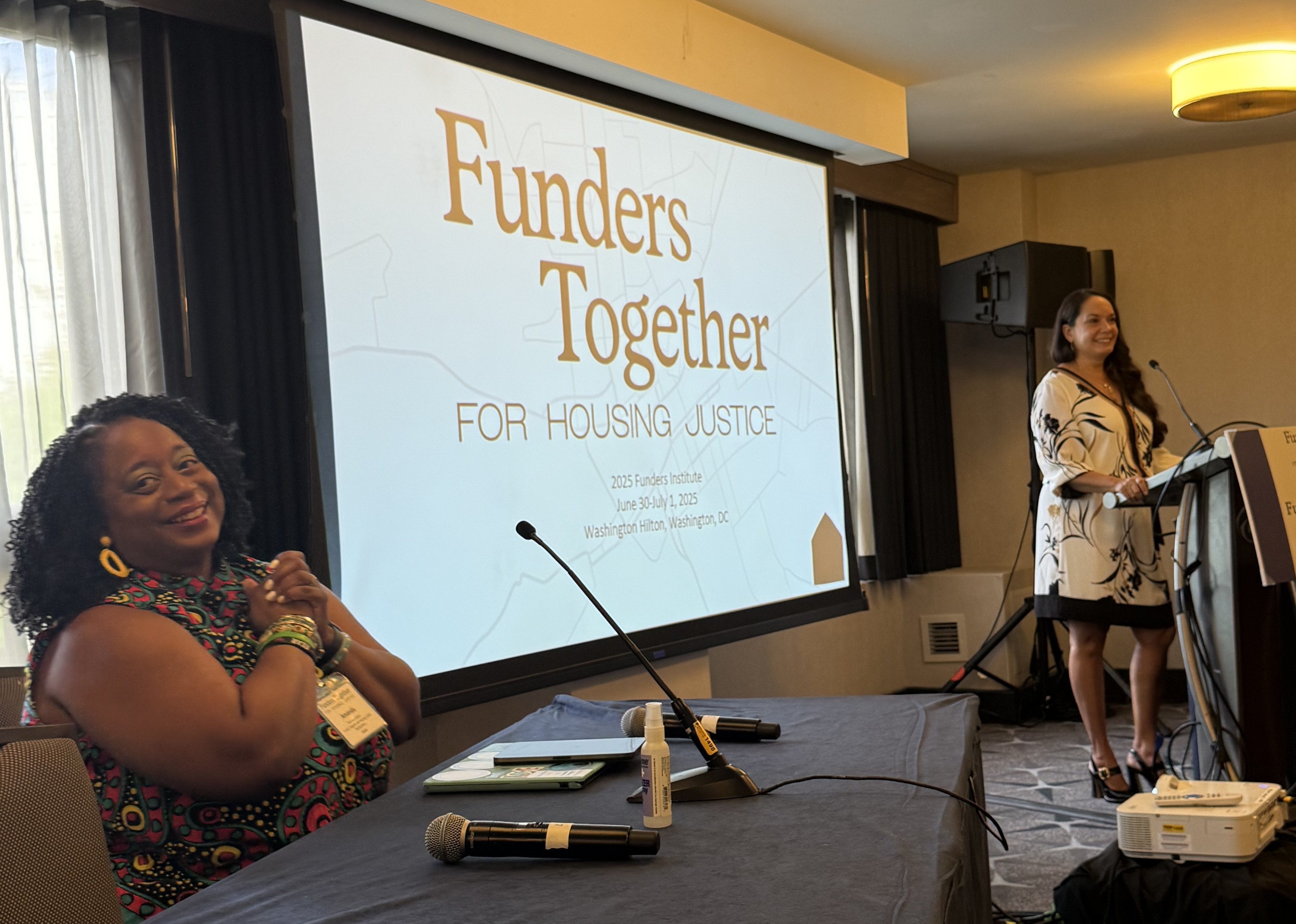 Amanda Andere (left) and Ann Oliva (right) hold a moment of joy during the 2025 Funders Institute
She made a call-to-action for philanthropy to be bold and strategic to meet the current (and probable long-term) moment we are in. She stressed the importance of local funders bringing community partners together to share information and ideas, explore risk mitigation, and practice self and community care for each other. Philanthropy also plays a crucial role in the narrative about what is happening, who is being impacted, and where people can go for support and resources. Funders should also resource organizations to make extra space for staff and leaders who are directly impacted by the Administration's various attacks on things that don’t directly have to do with homelessness, especially for people who are immigrants, queer, Black, Indigenous, neighbors of color, and/or disable folks. In these moments, caring for each other is a priority every organization and every person committed to housing justice should have.
She left participants with the reminder to not comply in advance. Harmful policies will continue to come down at the state and federal levels, but stay the course in building towards a more justice-oriented country.
View the recording and resources for this session.
Plenary: Block & Build – Federal & State Policy Outlook
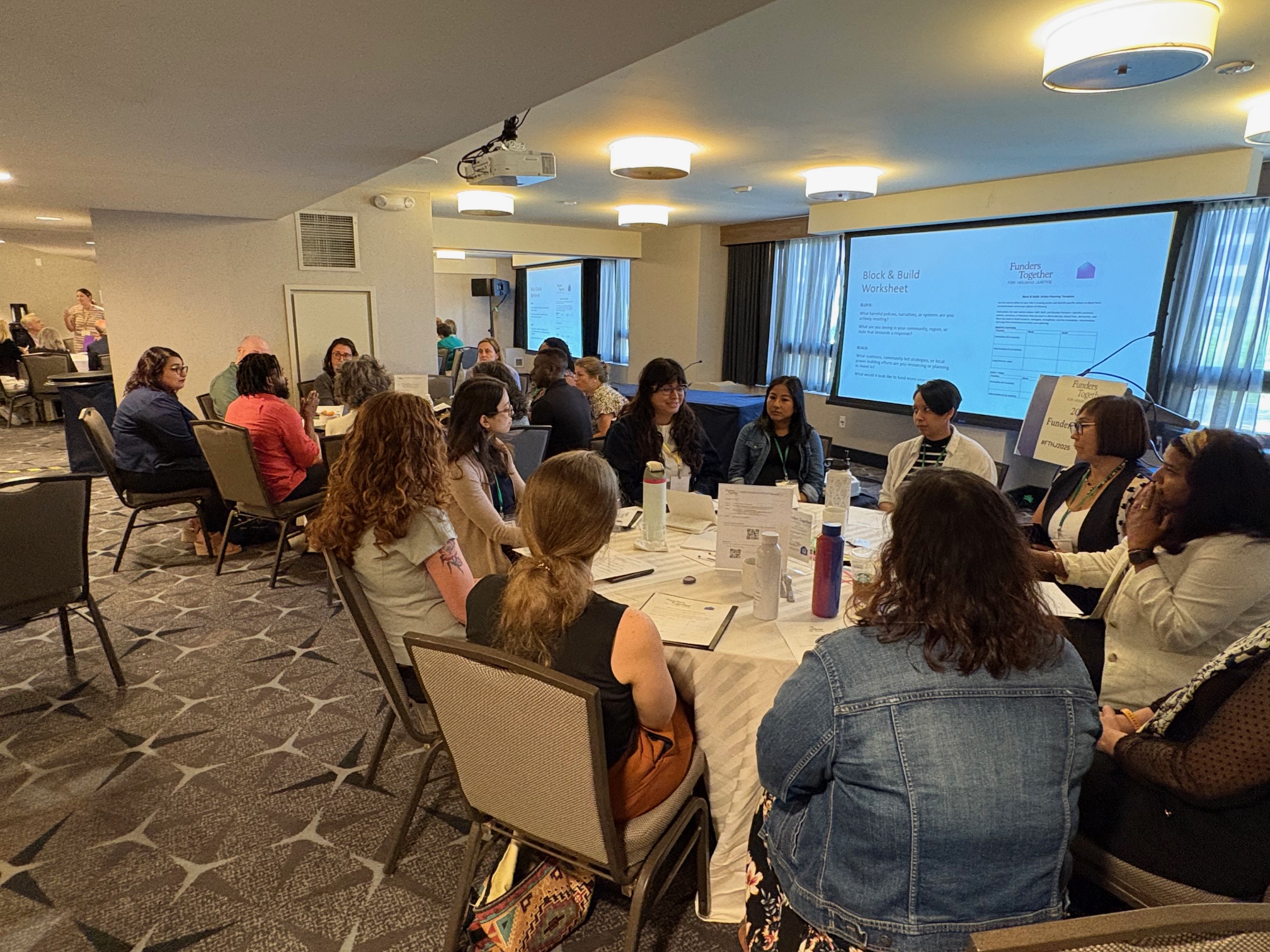
Our plenary session featured a conversation with national leaders on how federal and state policy developments are shaping the current housing and homelessness landscape. Panelist provided updates on recent legislation and discussed strategies for philanthropy to both “block” harmful policies and narratives and “build” a more just future through coordinated investment and advocacy.
They described how recent policy proposals, including the federal tax reconciliation bill, pose significant threats to programs essential to the well-being of our communities, like Medicaid and Supplemental Nutrition Assistance Program (SNAP). These proposals, if enacted, would result in deep cuts to programs and services that folks need to survive and stay stably housed. Speakers stressed that these developments are part of a broader political context and emphasized the need for philanthropy to align more intentionally to defend against policy rollbacks and narrative shifts.
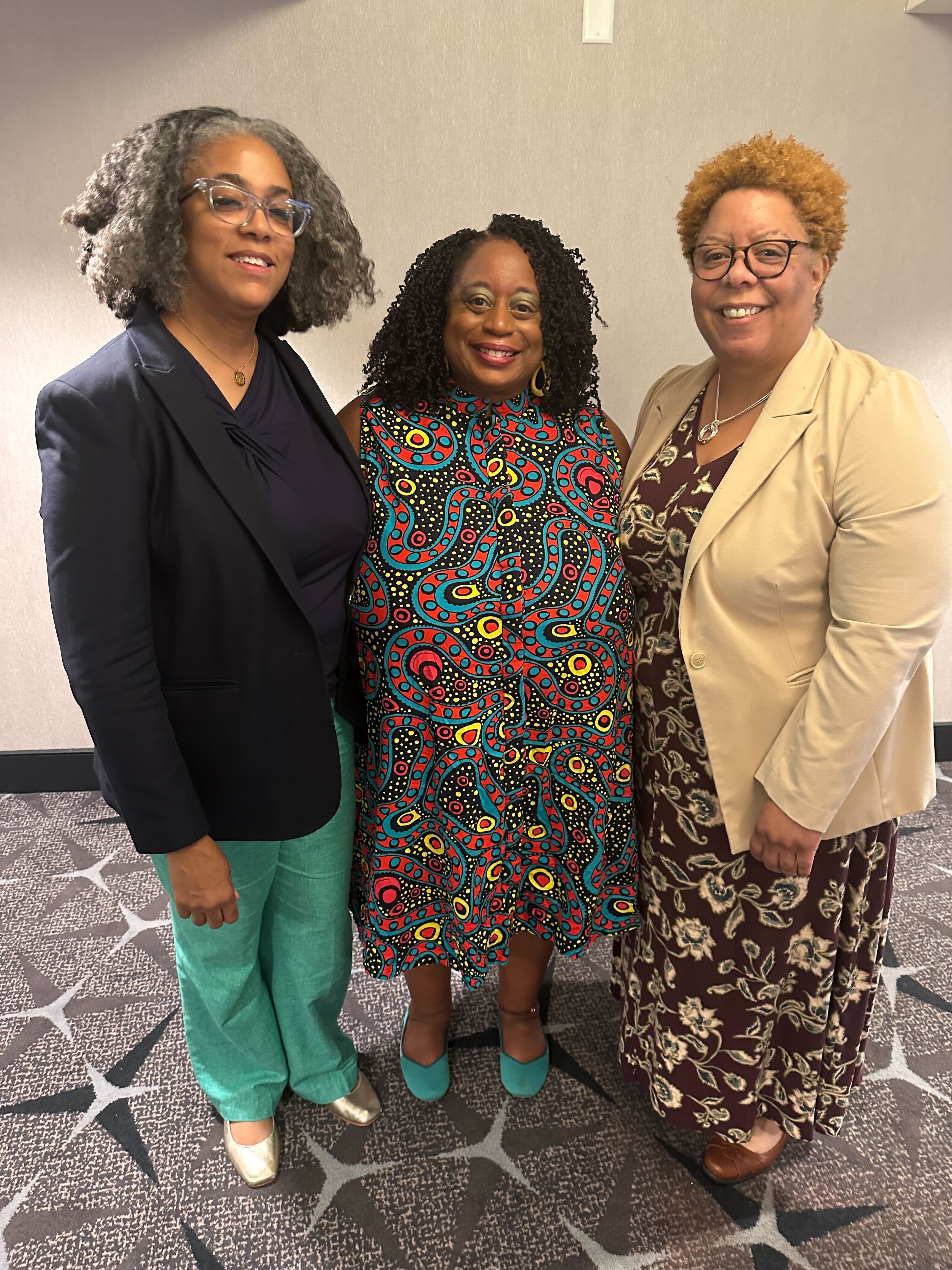
Renee Willis (left), Amanda Andere (center), and Peggy Bailey (right) at the 2025 Funders Institute
Jennifer Angarita of the Fund for Housing and Opportunity described the current political moment as “existential,” identifying demographic shifts and the transfer of wealth to the top 1% as driving factors. She encouraged philanthropy to adopt a multiracial democracy as a guiding vision. Renee Willis of the National Low Income Housing Coalition emphasized the need to amplify community-led solutions and resource state and local organizers already doing the work.
Peggy Bailey of the Center on Budget and Policy Priorities spoke about how harmful narratives, such as framing people as “deserving” or “undeserving” of housing, continue to shape policy and public perception. She challenged funders to move beyond symbolic support to examine the power structures they uphold to help shift long-term power dynamics.
Shameka Parrish-Wright of VOCAL-KY shared about the importance of supporting housing justice organizers on the ground. Local and state wins are only impactful when they are spearheaded and led by local organizers and activist who know their communities best. Simultaneously, these are also the people and groups who are often left out of abundant funding, so philanthropy has the opportunity and responsibility to resources people in community if policy wins are to achieve the outcome we want.
Panelists also reflected on how philanthropy can draw lessons from the opposition's funding strategies, including coordination around shared priorities, long-term investments, and the use of media and culture to shape public opinion.
View the recording and resources from this session.
Joy Fest: From Policy to Practice
This year’s Joy Fest session highlighted the power of local advocacy and community-led solutions, offering funders tangible examples of how aligned, long-term support can drive meaningful policy wins. Each speaker emphasized the importance of showing up differently as funders by centering lived experience, building trust, and embracing joy as a core part of strategy.
Kate Levin Markel of the McGregor Fund opened the session by reflecting on the harm caused when systems and institutions fail to center people most impacted. She lifted up the work of the Detroit Phoenix Foundation, a grantee partner led by advocates with lived expertise in housing instability. Kate introduced a video featuring DPF’s Courtney Smith, whose story illustrated the personal stakes and leadership behind local advocacy efforts. “I could not save my brother, but I could save his legacy,” Courtney shared, underscoring the deep connections between personal experience and public change. Kate also spoke about the value of prioritizing the resourcing of leadership, culture, and capacity and invited funders to consider what it means to “buy time” for their grantees.
Kristina Gray-Akpa of the Horizon Foundation followed with a presentation focused on housing advocacy in Howard County, Maryland. As a public health funder, Horizon has prioritized housing affordability in response to clear community input. Kristina described how the foundation leverages its advocacy experience and relationships to help move local policy, including work around rent protections, sustaining homeownership, and strengthening housing systems. Their approach centers co-creation, ecosystem-building, and a willingness to embrace risk when needed.
Deborah Vo of the Rasmuson Foundation closed the session by grounding attendees in Alaska’s unique context. She opened in Yup’ik, honoring her Indigenous heritage, and spoke about the importance of place-based, culturally grounded approaches. Deborah shared examples of investments in permanent supportive housing for Native elders and 3-D printed homes in remote areas—projects rooted in community need and local leadership. She described Rasmuson’s approach as “high touch,” characterized by availability, consistency, and humility. “Let the community decide what matters,” she said, offering a clear principle to guide philanthropic practice.
Together, the three talks offered a cohesive message: housing justice requires long-term relationships, trust in community leadership, and a commitment to joy—not as a distraction from the work, but as a sign of alignment and progress.
View the recording and resources from this session.
Day 2 Session: Shifting Systems, Building Power - A Call to Collective Action
The final morning of the Funders Institute opened with a powerful keynote from Kassandra Frederique, Executive Director of the Drug Policy Alliance. In conversation with Michael Durham, Kassandra offered a timely and urgent call to collective action, encouraging funders to examine how philanthropy can align across movements to confront the deepening criminalization of homelessness, housing insecurity, and racialized poverty.
Reflecting on her evolution from policy strategist to movement leader, Kassandra shared how her early years were focused on "the fight"—winning campaigns, passing laws, and securing policy wins. But she challenged the room to think beyond programs and legislation: “Fighting for policies and programming is not always the same as fighting for people,” she said.
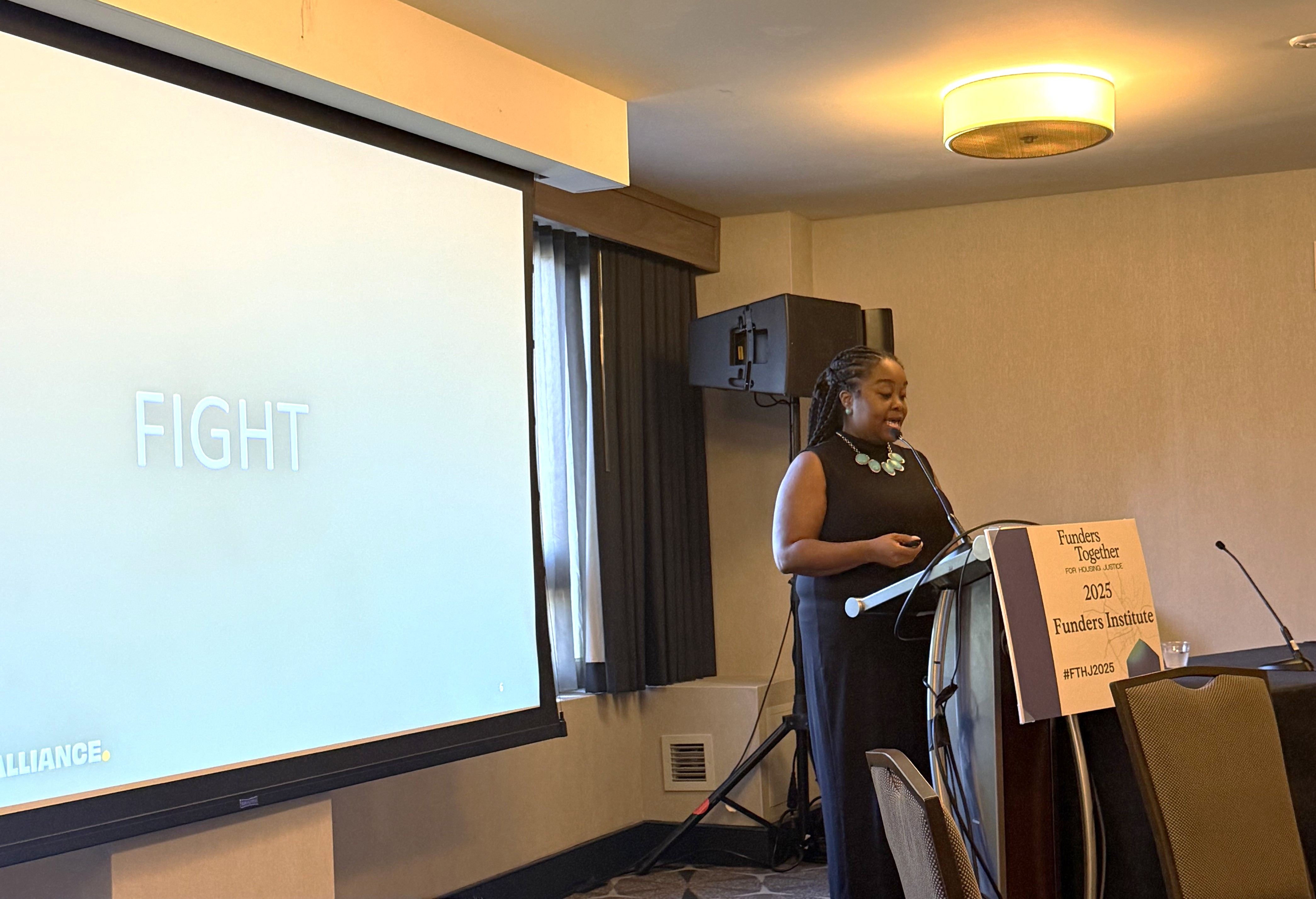 Kassandra Frederique presents to participants at the 2025 Funders Institute
Drawing on lessons from drug policy reform, Kassandra emphasized that the mechanisms of authoritarianism are already at work, targeting people through criminalization and eroding the foundations of democracy. She warned against siloed strategies and urged funders to consider where they are in their own cycle of work: in the fight, the grounding, or the shedding. "They don’t need to build housing if people are incarcerated, institutionalized, or gone," she said, highlighting the political incentives that perpetuate displacement and injustice.
Through candid storytelling and strategic insight, Kassandra called on the philanthropic community to build power, deepen coalition, and invest in long-term transformation. “Worldbuilding isn’t easy,” she said, “but it’s an opportunity to actually get what we want.”
View the recording and resources from this session.
Grounded in Justice: Our Values, Our Vision
To close out the Institute, Funders Together premiered a short film unveiling our new organizational values. These commitments—rooted in love, accountability, and radical imagination—will guide our future work and partnerships as we move forward as Funders Together for Housing Justice.
- A Pro-Black, Pro-Indigenous, and Pro-LGBTQ Stance
- Unapologetic Boldness in Love and Disruption
- Principled Struggle and Nuance
- Imagination, Curiosity, and Abundance
- Solidarity and Examination of Power
- Community and Community Care
- Joy
- Honoring of Ancestors
These are not just aspirations—they are practices that reflect our purpose and shape how we engage with philanthropy and community. Watch the full video to hear from our staff about how these values ground our work and collective vision for justice.
Reflections on leadership, legacy, and the future of housing justice
Closing the Funders Institute, staff took a moment to acknowledge how Amanda and Stephanie’s legacy is woven into every part of our, work, new name, and values. From our first public commitment to racial equity to our current work centering housing justice as racial justice, they have guided Funders Together toward a vision of philanthropy that is bold, grounded, and future-facing. Though this marks a leadership transition, it is not an ending—it is a continuation. As we look ahead to what’s next, we do so on a foundation that Amanda and Stephanie helped build: one rooted in courage, shaped by collective care, and steadfast in its commitment to justice. The future of housing justice is calling—and we will answer it together.
Showing 1 reaction