
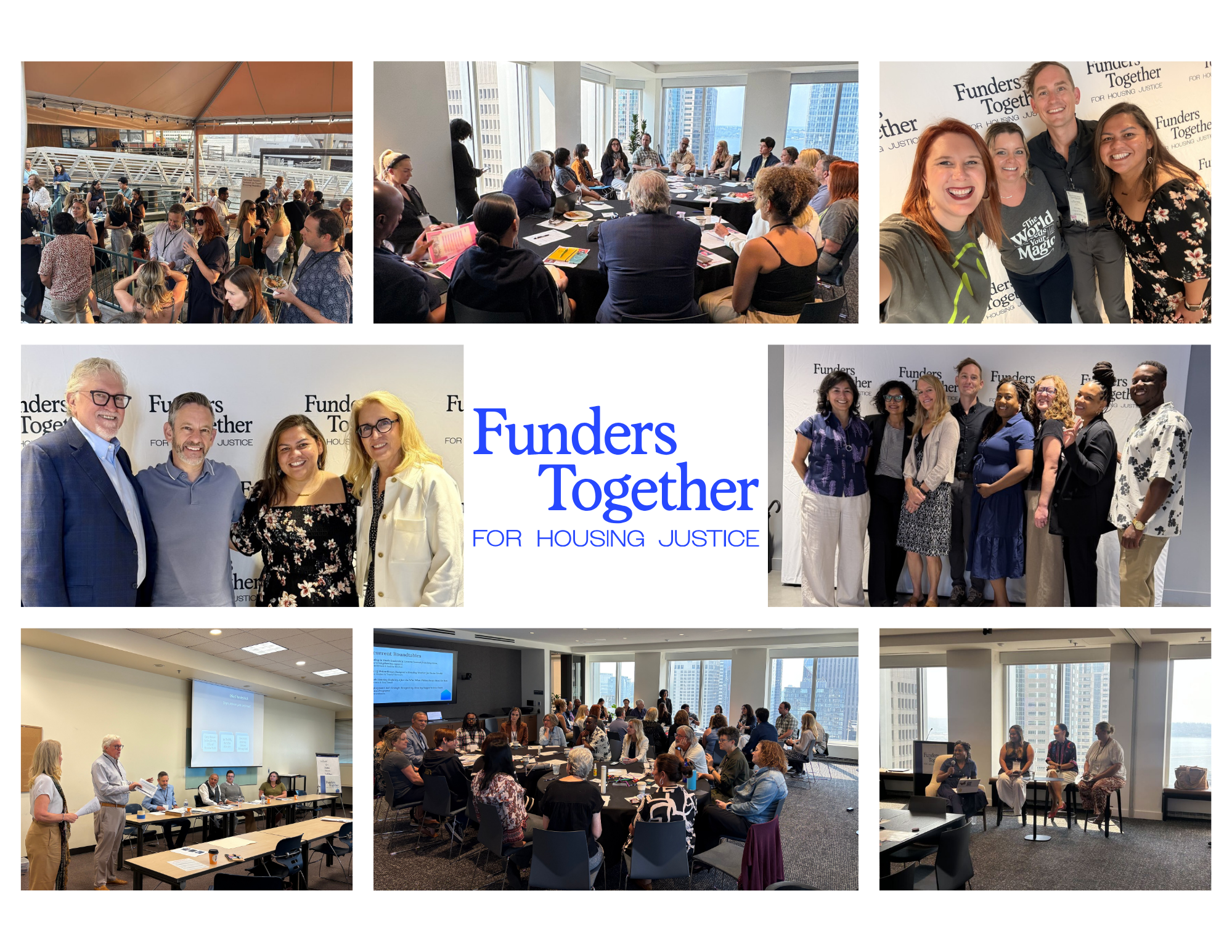
Nearly 80 philanthropic leaders gathered in Seattle for the inaugural National Funder Summit on Youth Housing Stability to imagine what it will take to prevent and end youth homelessness. From challenging our assumptions about reform and transformation to building stronger connections across sectors, the Summit offered a glimpse of what becomes possible when philanthropy expands the tent and thinks beyond crisis response.

First-time visitors to the Pacific Northwest could not have noticed just how drastically a wildfire haze veiled the mountain vista as we delighted in the waterfront scenery of our opening reception on the docks of Elliott’s Bay. Kicking off the National Funder Summit on Youth Housing Stability, we grounded ourselves in our individual stakes in the movement to prevent and end youth homelessness so that the workshops and activities that followed remained tethered to our personal “why” of this work. It was the perfect setting to welcome our new CEO, Rinal Ray, who spent just her second day on the job greeting nearly 80 colleagues in philanthropy who share a commitment to housing justice.
The Summit was an experiment. Funders Together for Housing Justice has hosted a network of grantmakers who focus on youth homelessness for years, which has gained momentum in its focus on prevention, but with a roster plateauing in the 30s. We were content to gather our regulars and hope for some newcomers, but could not have predicted the level of interest such that we exceeded capacity with five weeks to spare. Attendees included dozens who do not (yet) attend our bimonthly Youth Homelessness Funder Strategy circles, many of whom work in adjacent sectors, such as early-childhood, foster care, or juvenile justice. Our vision was to acknowledge where we are - and whom we currently represent - but grow and revitalize this body of philanthropic leaders toward a more comprehensive, cross-sector vision of youth housing stability.
“As a co-host of last month's funder summit here in Seattle, our trustees and staff were thrilled to work alongside so many peers committed to preventing and ending youth homelessness. The philanthropic sector focused on youth housing stability has needed revitalization for some time, and we now have the conditions to make that happen. Funders Together for Housing Justice is best positioned to guide us all toward alignment, accountability, and meaningful action. In my decade-plus in philanthropy, I have never seen as much engagement in youth homelessness. I encourage you to invest in the exciting and growing convening and coordinating power of Funders Together. The 'togetherness' in their name is not trivial — it is strategic.”
Casey Trupin, Raikes Foundation
We Start Where We Are
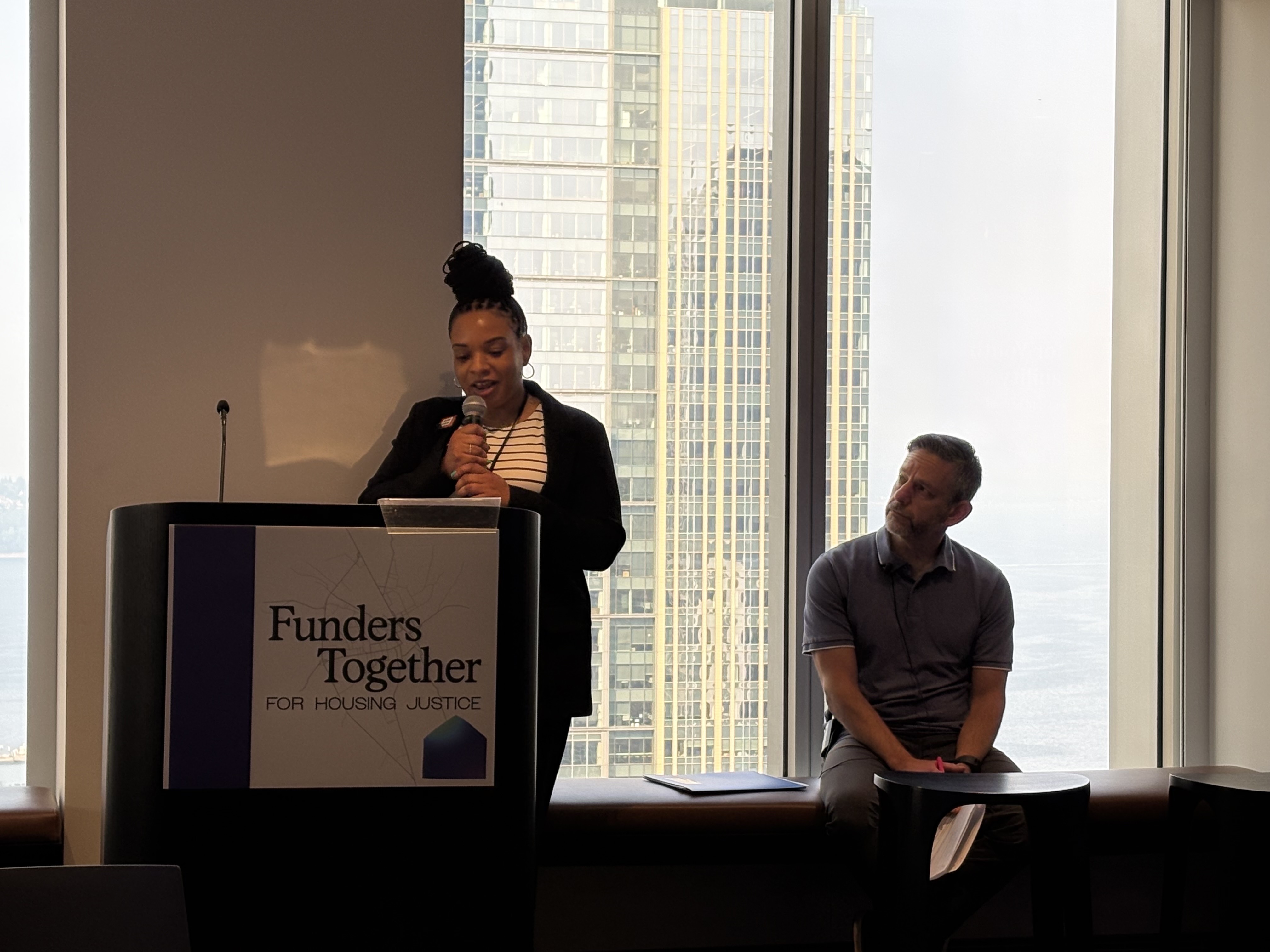
The arc of the full-day program on August 5 did just that: starting narrow and ending broad. Following generous remarks from Jeff and Tricia Raikes, founders and trustees of the Raikes Foundation, Michael Durham’s framing acknowledged members’ conflicting reception of our name change from Funders Together to End Homelessness to Funders Together for Housing Justice. Many appreciate the connotation of antiracism and structural analysis that “housing justice” evokes, in addition to the emphasis on prevention and housing abundance. Others now struggle to see themselves in our work as they remain focused on the interventions that alleviate the suffering of those who are already unhoused. Michael implored the audience to think “yes/and”: yes, we must attend to the systems that produce homelessness in the first place and repair the harms of structural oppression if we are serious about ending (youth) housing insecurity, and, preventative interventions do little for young people and families who are unstably housed tonight. We must cling to the breadth of what’s necessary to achieve universal housing stability while doubling down on our commitment to justice.
Transformation to You is Reform to Me
Next we welcomed Funders Together’s own Rachelle A. Matthews, Sr. Director for Strategy & Movement, in conversation with Casey Trupin, Director of Youth Housing Stability at the Raikes Foundation, which co-hosted our convening. Rachelle and Casey reflected on the progress the national youth-homelessness movement has made in recent years, despite a hostile federal administration and economic conditions that destabilize housing for thousands. They introduced and transposed two frameworks that help housing advocates contextualize any given policy or intervention (e.g., the Prevention of Youth Homelessness Demonstration Program (PYHDP)). Drawing from A Way Home America’s New Deal, the “reform-to-transformation” continuum visualizes interventions that reduce harm within systems that currently exist in comparison to those that make no assumptions about current restraints and engender the conditions that would obviate crisis-response. The “block and build” framework, secondly, identifies harmful policies that must be defended against in comparison to long-term, generative policies we must promote. Using the wings of the convening space to represent each pole, participants stood where they believed interventions like PYDHP fall on the reform-to-transformation continuum.
The key takeaway from this exercise was the diversity of analyses represented by attendees’ engagement with the continuum: the room was split. That some believe PYHDP would be utterly transformative while others maintain that it is reformist signals the need for deeper political education and more time with this framework. It also represents the reality that even reformist policies would be herculean achievements in this environment - people think that a small win is transformative just because it was hard-fought. Our political conditions have lowered our standards for success.
Dispatches from the Field
“The summit was an amazing opportunity to connect with peers in the field. The schedule was thoughtfully designed, balancing a strong lineup of speakers with time for meaningful and productive conversations on youth homelessness. I left feeling inspired, energized, and ready to push the work forward. In today's uncertain political landscape, it feels good to be surrounded by hopefulness and camaraderie, and to be reminded that these problems are solvable.”
Demaree Miller | Program Officer, Housing & Homelessness | Charles and Helen Schwab Foundation
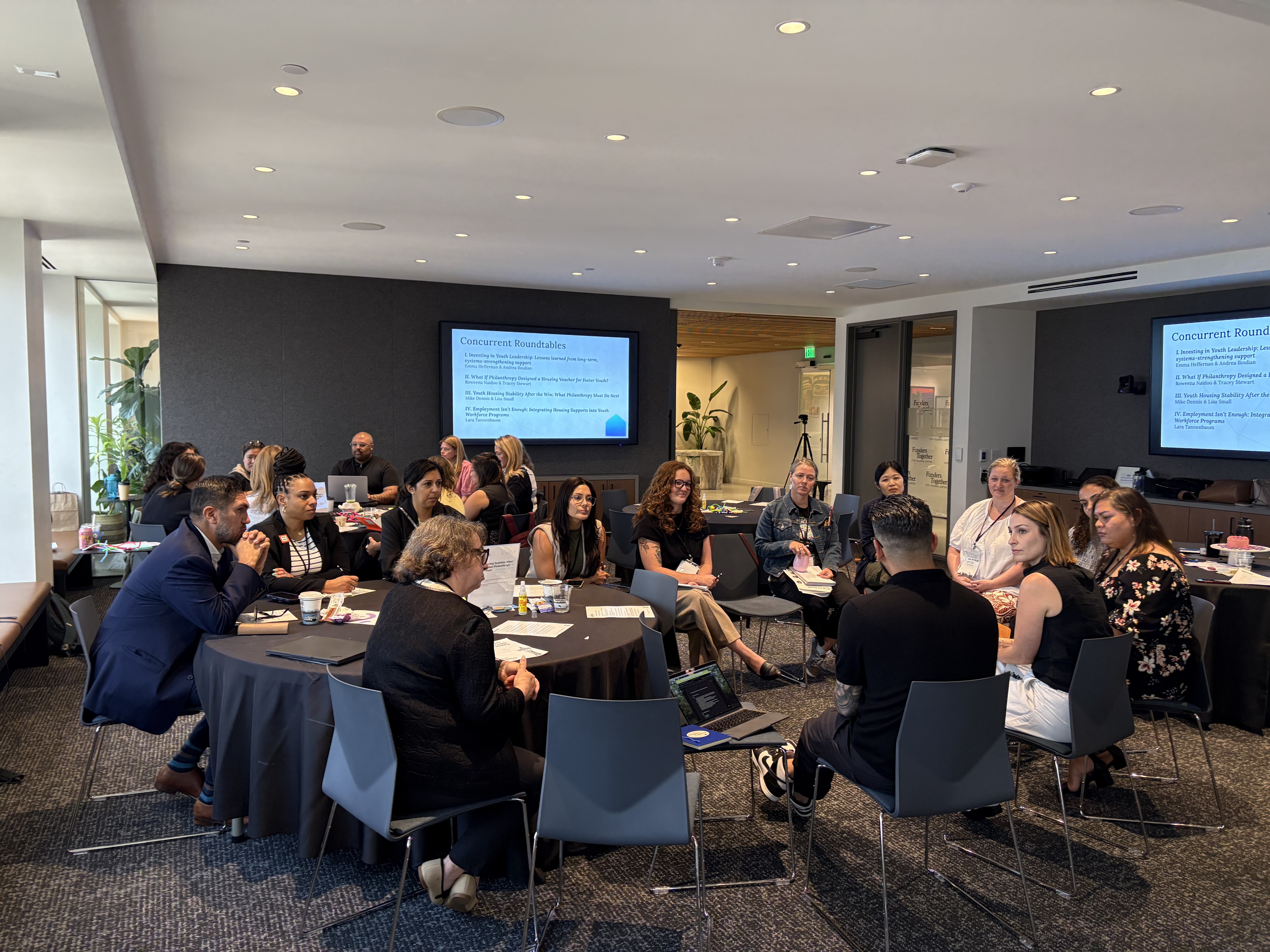
Funders Together had solicited proposals from the field to inform this funders-only affinity space. Four concurrent roundtable discussions, then, represented snapshots of philanthropy’s priorities and utterly practical glimpses into funders’ strategies for engaging in this work.
Mike Dennis and Lisa Small from Liberty Hill Foundation facilitated conversation on the role of philanthropy in supporting cross-sector movement ecosystems to implement policies after they’ve been won by advocates. Participants took away sobering insights into what it takes to protect wins from being watered down or outright reversed by adversaries, such as has been the case in Measure ULA.
Lara Tannenbaum described Tipping Point’s observations of the role of employment in youth housing stability by recounting their Bay-Area experience of identifying the need for housing supports within workforce development initiatives for young people. In addition to this lesson’s improvements of the grant strategy, the cross-sector introductions and collaborations it generated were equally impactful.
Tracey Stewart from Colorado Health Foundation and Roweena Naidoo from Mile High United Way used their experience in Denver of developing a voucher program for foster youth to explore the intrastate differences in resources available to young people impacted by the child welfare system. The discussion elevated the limitations of policy advocacy: when public systems continuously fail and remain resistant to reform, philanthropy can sometimes create alternative systems outside of government.
Finally, Emma Heffernan from the Conrad N. Hilton Foundation and Andrea Iloulian from Cedars-Sinai reflected on philanthropy’s journey in supporting the leadership of young people with lived experience to sustain governance positions in LA county and the myriad lessons the last five years have produced. It took a ton of work, abundant humility, and millions of dollars, but has cultivated a widespread expectation in LA governments that young people must contribute to the policies that affect their lives.
Whatever it Takes
Our post-lunch energizer featured Becks Heyhoe-Khalil and Kristene Peters of United to End Homelessness, a program of Orange County United Way. Through TED-style storytelling, they walked our audience through their comprehensive youth-homelessness prevention and diversion initiative that wields any available resource to identify young people on the brink of homelessness and prevent them from entering the homelessness system at all. View their presentation in its entirety online.

Please note: Technical challenges during the event affected the quality of the video and audio. We’re grateful to still be able to share this recording with those who weren’t able to join us in Seattle.
It’s 2050. We Halved Youth Homelessness. How?
In an exercise of futurism, participants then imagined we were living in 2050 and reflecting on the quarter-centery achievement of having reduced youth homelessness by half. We imagined this hypothetical through five lines of inquiry:
-
-
- What did the so-called youth homelessness sector start to prioritize? What did it stop doing?
- What other sectors were instrumental in our collective success? How so?
- How did young people with lived experience shape the policies, investments, and systems that ultimately reduced youth homelessness?
- What were the political conditions that enabled this drastic reduction? What pressures created those conditions?
- How did philanthropy show up differently? What was funders’ role?
-
Again, it was the range that stood out. Many found the exercise anxiety-inducing, especially the groups that entertained the role of AI in both the economic conditions of 2050 and its influence in the homelessness sector. Others, however, felt that a reduction by half was underwhelming and that a complete elimination of youth homelessness was possible by 2050. Even so, the interventions that the majority of groups surfaced pertained to: reducing silos between systems; a complete re-orientation toward prevention and away from shelters; the growth of resources in our sector (we playfully imagined more billionaire divorces a la McKenzie Scott); widescale expansion of direct cash transfers; the expulsion of fascists through elections at all levels of government; and an appreciation of the whole family and community in any given young person’s ability to thrive.
A Bigger Tent for a Stronger Movement
“I left the convening energized and informed, I am so glad that I attended. We are working to carry the ideas forward here in Chicago. One of the most valuable aspects of the Summit was the opportunity to explore the complexity of youth homelessness from every angle alongside such a dedicated group of funders. Hearing diverse perspectives, successes, and opportunities reinforced for me that lasting progress requires centering youth voices, while also investing further upstream in prevention efforts that can stem the tide of youth homelessness. The conversation about what it would take to get closer to functional zero was both enlightening and inspiring, offering a powerful vision of what is possible when we work together.”
Shana Hayes, The Northern Trust
The final plenary panel welcomed philanthropic leaders from sectors outside of youth homelessness - those who don’t usually attend a homelessness conference. Our intention was to envision a broader philanthropic alliance for youth housing stability by learning from funders in adjacent sectors about their analysis of housing/homelessness and identifying our own potential influence in theirs so that “we” includes all of us.
Angela LoBue is the senior program officer for the foster youth initiative at the Conrad N. Hilton Foundation the Child Welfare Funders Collaborative; Michaela Pommells is the Executive Director of Youth First Justice Collaborative, an intermediary working to end youth incarceration; and Laura McCargar is the Executive Director of the Funders Collaborative on Youth Organizing (FCYO). They joined Maegan Scott in a vulnerable discussion that combined their lived experiences with an honest assessment of our fields’ shortcomings.
- WATCH: webinar: Youth Organizing for Youth Housing Justice featuring Laura McCargar
The room was shook by the themes that emerged from the conversation about lived experience, one that Funders Together’s own partners at A Way Home America often repeat: that personal experience of homelessness does not equate to root-cause analysis of the housing crisis. Philanthropy tokenizes young people when it conflates the two.
The discussion opened more questions than answers: what would incentivize the foster and juvenile justice sectors of philanthropy, in particular, to more meaningfully synthesize their priorities with the youth-homelessness corner of philanthropy? How would direct-service programs experience that? What is possible within the current administration to advance those shared visions? How do we transcend youth-informed decision-making toward building youth power through organizing? It is our collective assignment to ensure answers to these questions.
The Story of Washington
On our final day, we broke out of our funders-only confines to visit the 2100 Building, which hosts the offices of several youth-homelessness organizations in Seattle. Using Washington’s progress as a case study, two consecutive panels included representatives from Washington state government, nonprofit partners, lobbyists, Washington foundations, and young people with lived experience.
While we lacked sufficient time for discussion - a consensus sentiment - the insight into the collaborative effort to reduce youth homelessness statewide and the role of philanthropy was unmatched. And, as Jeff and Tricia Raikes emphasized, having joined our group again, this progress should not bely the work that remains nor underestimate the headwinds we face.
The Raikes Foundation, Campion Advocacy Fund, and the Schultz Family Foundation, in particular, have offered their wisdom through many formats. Peruse the resources below to learn more about the Washington model.
The Raikes Foundation, Campion Advocacy Fund, and the Schultz Family Foundation, in particular, have offered their wisdom through many formats. Peruse the resources below to learn more about the Washington model.
- WATCH: 2024 webinar Washington State Reduced Youth Homelessness 40% and You Can, Too
- The Story of Washington Recap
- “Yes to Yes” Washington State: Unaccompanied Youth and Young Adult Homelessness Landscape Scan
“Funders don't always make time to compare notes. When we do, and when we're honest about what's working and what isn't, it surfaces things no data set can.
That’s what happened this week in Seattle at the National Funder Summit on Youth Housing Stability, hosted by Funders Together for Housing Justice, which helped surface key insights for me:
Progress is a group project. No single funder, no single program, no single organization prevents and ends youth homelessness alone. The states that are actually changing outcomes are the ones where government, philanthropy, providers, and young people are rowing in the same direction, long enough for the results to be felt system-wide.
Young people aren’t just the people we’re trying to serve. They’re the ones who know where the gaps live. When young people inform and lead our investments, we get better policies and outcomes. Having those closest to the problem shape the solutions is what differentiates programs that manage a crisis from systems that prevent it.
Lastly, philanthropy's edge isn't scale; it's nimbleness. The ability to get in early, stay when it gets hard, and fund what others are still debating.”
Tricia Raikes | Co-Founder | Raikes Foundation
What Attendees Valued Most
“FTHJ's Youth Housing Stability Summit provided helpful programming in an interactive format with space for learning, conversation, and relationship-building. As a leader of a funder collaborative, it felt particularly generative to hear from funders—including Tricia and Jeff Raikes personally—how philanthropic leaders in Washington built partnerships, invested resources, and moved the needle in ways that the community can see.”
Mary Kate Johnson | Director | Bay Area Funders Together to End Homelessness
Through evaluation surveys, informal debriefs, and unsolicited shoutouts, we can only conclude that the Summit was an outrageous success. While we hope to report concrete actions and practice-change as a result of our convening over the coming months, we can attest for now that participants felt connected, informed, valued, convicted, and motivated to ramp up their support of youth housing stability. While the downsides of having limited participation (including via speakers) to just philanthropy should not be understated, the funder-only environment created an affinity space where program officers and other foundation staff could connect in solidarity over their shared experiences, challenge each other, and scheme up collaborations. The peer-to-peer emphasis was also conducive to more pragmatic education than Funders Together’s events can sometimes offer. Indeed, it was members who have attended dozens of FTHJ convenings that praised the Summit the most, even as newcomers felt especially welcome.
“This was the best Funders Together event I've attended! Thank you to everyone who made it so special and energizing!”
Becks Heyhoe-Khalil | Orange County United Way
Among many other roles, Funders Together is a convener: it is a sense of belonging alongside accountability that we design, and there is little doubt that we hit that target in Seattle.
Where We Go From Here & How You Can Join Us
We are eager to build on the momentum the Summit inspired. If your work supports the overall vision of youth housing stability, please consider joining Funders Together as a member. Membership then affords you access to the bimonthly convenings of the Youth Homelessness Funder Strategy Circles, taking place on the 4th Tuesday of the odd months, in addition to many other benefits. FTHJ staff are eager to connect with you about your housing/homelessness strategy and offer thought partnership and peer introductions. We are also eager to make new partnerships with philanthropic and advocacy organizations whose missions bear upon on our own. Please reach out!
Finally, while details are slim, we know enough to announce that we will be back for a second National Funder Summit on Youth Housing Stability in 2027, probably on the East coast. Budget accordingly!
In solidarity,
The Funders Together team
Showing 1 reaction